
AI-Enabled Product Management: The CEO Playbook Series
Over the past few decades, digital transformation has been driven by technology adoption. The next decade will be defined by AI-enabled product thinking — the ability to translate strategy into products that learn, adapt, and deliver business outcomes continuously.
AI-Enabled Product Management: The CEO Playbook Series
Blog 1: The Rise of AI-Product Companies — And Why Every CEO Must Think Like a Product Leader
Over the past few decades, digital transformation has been driven by technology adoption. The next decade will be defined by AI-enabled product thinking — the ability to translate strategy into products that learn, adapt, and deliver business outcomes continuously.
This shift is no longer optional.
Companies that operate like product organizations — not project organizations — are the ones building lasting competitive advantages. And AI has only accelerated this gap.
Why Traditional Digital Transformation Stagnates?
Most organizations follow a predictable pattern:
They invest in new platforms.
They hire system integrators.
They run projects in waves.
They expect transformation to “settle” after go-live.
But transformation is now permanent. New regulations, integrations, analytics needs and AI use-cases keep emerging.
The problem is not capability. The problem is operating model.
Project-based thinking creates:
Fragmented data
Siloed applications
Heavy dependency on tribal knowledge
Slow decision-making
No continuous improvement motion
This is why CEOs increasingly ask: “How do we run transformation like a product, not a project?”
Enter the AI-Native Operating Model
In an AI-native organization:
People and AI share decision-making
Knowledge is codified, not silenced inside teams
Products evolve with feedback, not rigid timelines
Data becomes a strategic asset across the company
Governance becomes continuous, not a once-a-year audit
This is how the world’s fastest movers scale their advantage.
AI-native product organizations integrate:
AI Agents to automate complex work
Data as a Product for trust
Productized Operating Models for consistency
Digital Twins (AI Agents) for critical roles
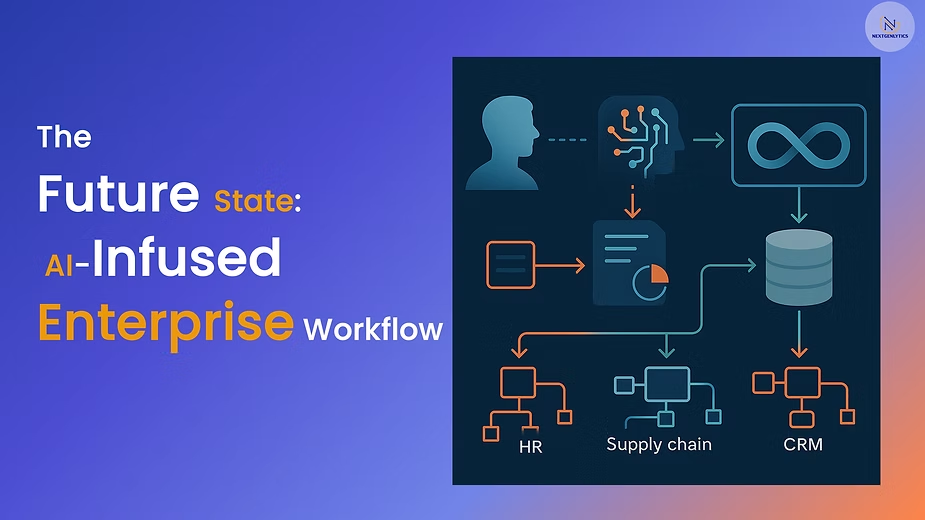
Suddenly, every transformation stream — finance, supply chain, HR, CRM — starts behaving like a product with lifecycle management.

This gap between AI-native ambition and real-world execution is exactly why BlueGecko was built.
When we founded Nextgenlytics in Amsterdam, we saw the same pattern across every digital transformation program:
Enterprises had data, but they did not have a unified operating model that connected all the roles shown in a modern governance structure — from CXOs to Data Stewards, from System Custodians to Architects.
Most programs were held together by:
People’s memory rather than institutional knowledge
Legacy documentation that was outdated the moment it was created
Excel-driven mapping that created silos
Multiple vendors working in isolation
New team members onboarding slowly because nothing was standardized
No single place where business, IT, data, and architecture came together
This created friction across all governance layers — Steering Committees, Data Owners, Architects, System Custodians, and Data Stewards.
Why BlueGecko Had to Be Built
Instead of building another migration tool or governance dashboard, we built BlueGecko as an AI-enabled, enterprise-wide Data & Digital Operating Layer that mirrors the governance architecture you see above.

BlueGecko creates a Digital Twin (AI Agents) for every critical role, including:
Data Owners & Process Owners
System Custodians (ERP, AS/400, CRM, SaaS, DWH, etc.)
Enterprise, Integration & Domain Architects
Data Stewards & Key Users
Data Engineers, Quality Teams & ICT SMEs
Migration Leads & ETL Developers
It becomes the connective tissue across the entire governance architecture — business, ICT, and data.
Where AI Meets Operational Discipline
AI agents inside BlueGecko don’t replace teams — they augment them:
Falcon Mapping → AI Data Steward Agent
Code Cheetah → AI Data Migration Engineer Agent
Owl Sight → AI Data Quality Analyst, GRC Agent
These AI agents embed directly into the Data Operations & Stewardship layer and the ICT Enablement layer — ensuring that every part of the governance model operates consistently, continuously, and intelligently.
The Result
BlueGecko transforms fragmented governance into a living, AI-driven operating model that:
Aligns business, IT, and data roles
Standardizes processes across systems and countries
Reduces dependency on tribal knowledge
Creates continuity across waves, phases, and vendors
Operates like an AI-native product organization
This is why BlueGecko is not just a tool — it is the operating layer for modern digital transformation.
This is why CEOs must rethink how they run digital transformation
A CEO today is no longer just running a business. They are running a portfolio of digital products:
Core ERP
CRM
Data platforms
Customer platforms
Analytics and reporting
Finance and supply chain systems
Every system has a lifecycle, requires ongoing adaptation, and depends on consistent governance.
CEOs who embrace product thinking create organizations that:
Move faster
Reduce operational risk
Scale transformation beyond vendors
Build IP and knowledge internally
Attract better talent
Make AI a strategic advantage, not a buzzword
This is the new leadership playbook.

Closing Thought
The companies winning in the AI era are not the ones with the most data or the biggest budgets.
They are the ones who run their transformation like a product, not a project — with AI as an operating partner, not an afterthought.
This mindset shift is what will differentiate the next decade’s market leaders.
At Nextgenlytics, we help organizations unlock the full potential of their data. Data isn't just about insights, it's about shifting the operational landscape to drive business velocity.