
Cookies and Related Technologies on This Site

    Nextgenlytics Logo

    Please choose whether this site may use cookies or related technologies such as web beacons, pixel tags, and Flash objects ("Cookies") as described below. You can learn more about how this site uses cookies by reading our privacy policy.

    Required Cookies

    Always Active

    Functional Cookies

    Advertising Cookies

    Privacy Policy
    Language:
    Powered by: Nextgenlytics
    New: BlueGecko Platform v2, accelerate SAP & D365 migration programmes by up to 50%
    Discover our AI Solutions, from AI Strategy to Predictive Analytics & Conversational AI
    Meet your Extended Delivery Team, embedded engineers governed from Amsterdam
    New on the blog: SAP Clean Core in 2025, what European enterprises must know
    Ready to see it in action? Book a personalised demo with our team
    HomeInsightsWhitepapersHow to Build a Token-Free AI Platform
    Whitepapers
    AI & DATA

    How to Build a Token-Free AI Platform

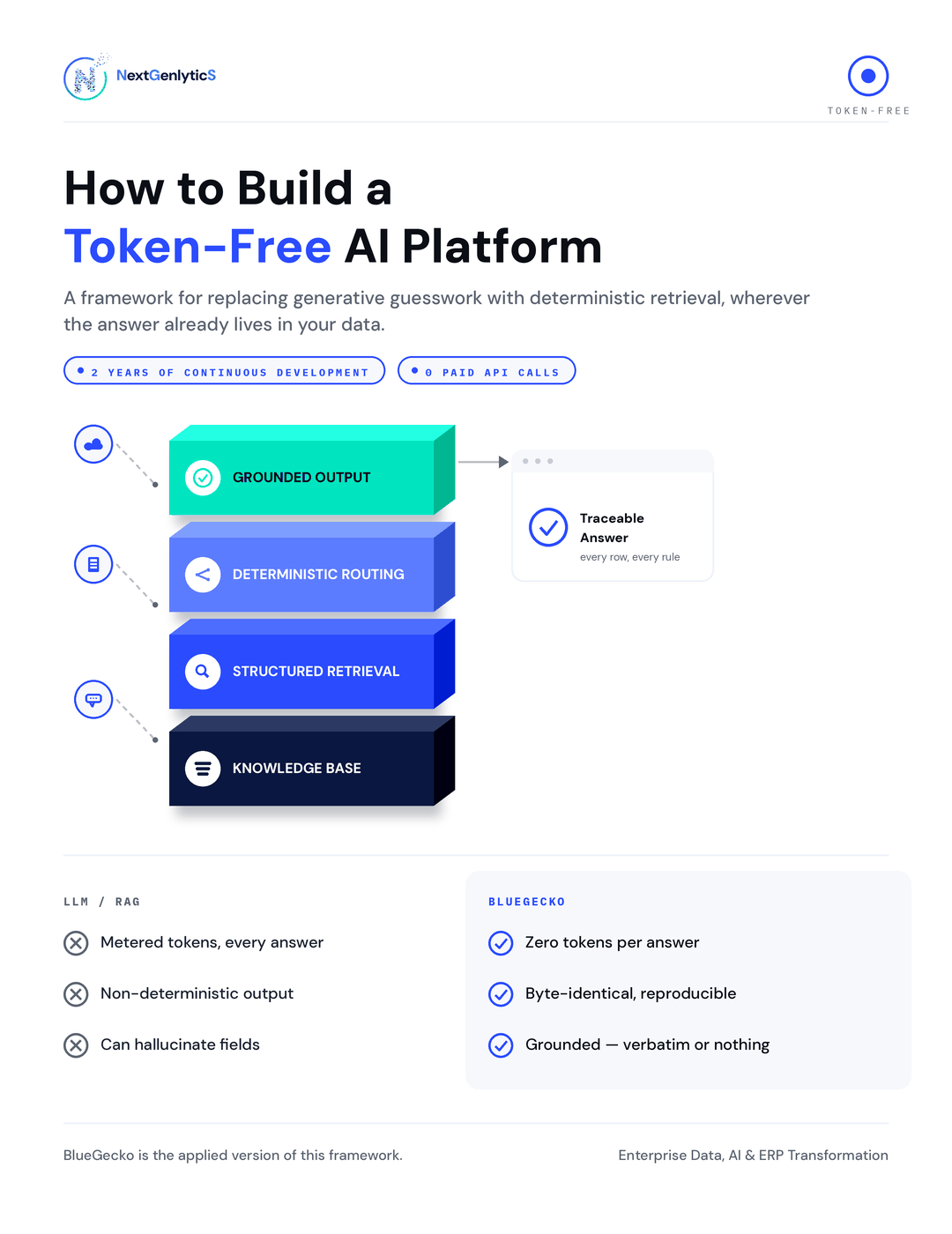
    This paper presents a domain-agnostic framework for building zero-token knowledge assistants that handle retrieval-shaped tasks without consuming generative LLM tokens on the answer path. By utilizing a deterministic four-layer architecture featuring intent routing, structure-first vector retrieval, and calibrated similarity scoring, the system ensures high reproducibility and auditability. Fielded enterprise case studies demonstrate that this approach successfully eliminates recurring API costs and latency, offering a robust and cost-effective alternative to traditional RAG baselines.

    BlueGecko TeamJul 23, 2026 10 pages
    BlueGecko

    This paper presents a domain-agnostic architectural framework for building zero-token knowledge assistants that handle retrieval-shaped tasks without consuming generative LLM tokens on the answer path. Designed specifically for structured environments such as enterprise ERP schema migrations, the system utilizes a four-layer deterministic core. This includes precise intent routing, structure-first vector retrieval with approximate nearest-neighbor fallback, and rule-hardened, calibrated similarity scoring. While an optional, time-boxed language model can be safely attached for text phrasing, the core engine operates entirely deterministically. Consequently, the approach eliminates recurring API expenses, minimizes tail latency, and guarantees complete reproducibility and auditability, offering a robust and highly scalable alternative to traditional retrieval-augmented generation baselines.

    Preview

    Showing the first pages only. Download the full document with your work email above.